Question #2717
closed

Linking successive events which are subevents of other events
Description
Example:
- A manuscript was bought in Istanbul: https://mamems.openatlas.eu/entity/6462
- The buyer took the manuscript with him to Vienna on his return trip: https://mamems.openatlas.eu/entity/1291
- A scholar later wrote notes on the manuscript in Augsburg: https://mamems.openatlas.eu/entity/7294
All three events are linked via tabs to the artifact entry for the manuscript (https://mamems.openatlas.eu/entity/4923), but the acquisition (event 1 above) is a subevent of the person's stay in Istanbul (https://mamems.openatlas.eu/entity/6462), so I cannot indicate the acquisition as the preceding event of the transfer (event 2 above) - the preceding event of the return trip is the traveler's stay in Istanbul. Is it possible to show the three events that form the history of the manuscript as successive events? This would also be important for the presentation website, to highlight the "biography" of the manuscript.
Files
 Updated by Alexander Watzinger 2 months ago
- Description updated (diff)
Dear Nicholas,
thank you for the question. I took the liberty to reformat the description for better readability (and because some links were broken).
I'm not sure if I understand the issue because it seems to be possible to "indicate the acquisition as the preceding event of the transfer (event 2 above)" - I just tested it locally.
Did you mean that the issue is, that there can be only one preceding event and you would like to have more possible?
 Updated by Nicholas Melvani 2 months ago
Thank you for your quick reply. I suppose you are right, the main problem appears to be that there can only be one preceding event. Is there a solution to this?
Updated by Alexander Watzinger about 2 months ago
- Status changed from New to Assigned
- Assignee set to Bernhard Koschiček-Krombholz
 Updated by Bernhard Koschiček-Krombholz about 2 months ago
- File issue_2717.png issue_2717.png added
- Status changed from Assigned to Closed
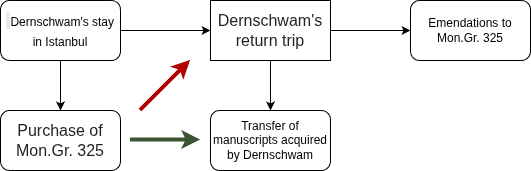
The current modeling in OpenAtlas is already correct and semantically sound. The connection you illustrated with the red arrow is not possible because we strictly use 1:1 relations for preceding and succeeding events. Switching to n:n relations would lead to significant confusion within the data, the user interface, and for us as well.
If you really want to define a succeeding event, you can correctly add Transfer of manuscripts acquired by Dernschwam. However, in our view, this is not strictly necessary because the events are already linked via P134 continued / P134i was continued by. Therefore, the semantic link is already established and correct.
The question of how to display this "biography" of the manuscript on the presentation website is a separate issue that belongs to OpenAtlas Discovery. From a data model perspective, you have done everything correctly: you have one main timeline with sub-events that should be linked within the scope of their super-event, but not directly to another super-event.
I know time is a bit "wibbly-wobbly" (to quote Doctor Who), but we need to stick to this structure to keep the data organized and manageable.
I will close this ticket; if another question arises, please open it again.
Updated by Alexander Watzinger about 2 months ago
Thank you Bernhard for this detailed explanation and the handy visualization of the issue.
I just wanted to clarify a minor detail which doesn't change the reported issue nor the valid answer from Bernhard but still might be helpful:
In OpenAtlas the relation preceding -> succeeding is 1:n, so an event can only have 1 preceding event but can have multiple succeeding events.